Makers of Ancient Strategy: From the Persian Wars to the Fall of Rome by Victor Davis Hanson
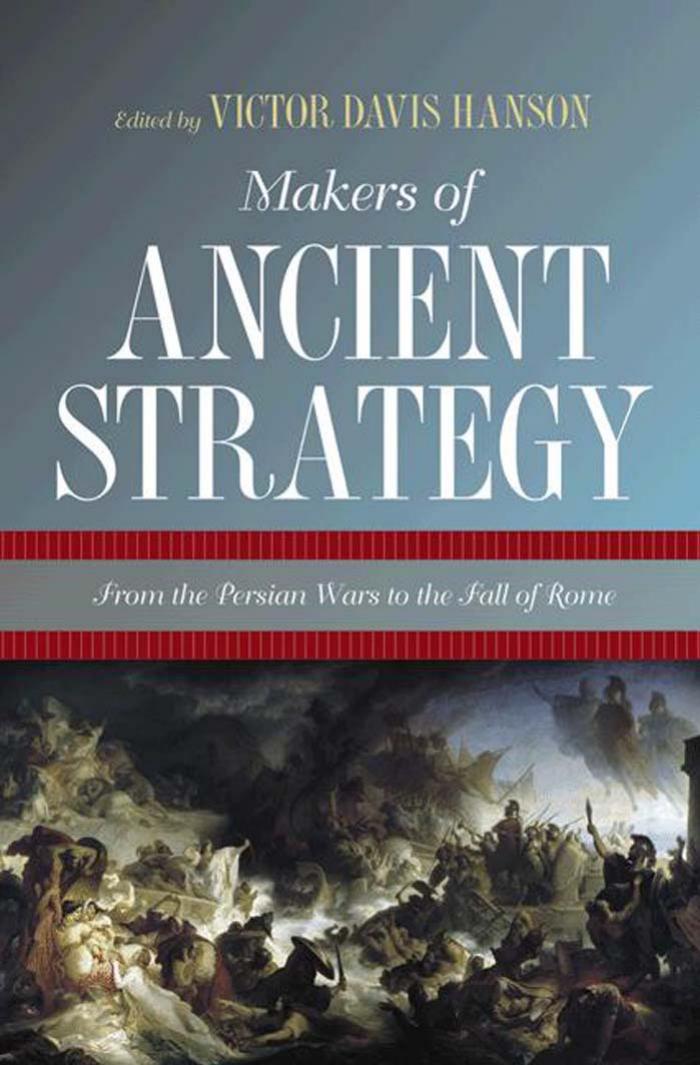
Author:Victor Davis Hanson [Hanson, Victor Davis]
Language: eng
Format: epub, pdf, mobi
Tags: Princeton University Press, 0691137900
Published: 0101-01-01T00:00:00+00:00
agora. Located at the junction of major streets and often containing
major administrative buildings, the agora was the largest open area
within the city walls. Foreign attackers entering a city usually headed
straight for the agora, and defenders typically fell back toward it.31 If
the defenders could hold on to the agora and reform their troops, they
stood a chance of pushing the attackers out of the city. The Athenians
and Ionians at Sardis in 499 BC, for example, were forced to fall back af-
ter they encountered Persian troops massed in the agora.32 Conversely,
the loss of the agora could be the final blow that crushed defenders’
morale.33 Even so, overconfident or outnumbered forces, like the The-
bans at Plataea, might find that taking the agora alone was insufficient.
Many civil wars began with coups or massacres in the agora.34 Again,
winning the agora did not guarantee victory, as the oligarchic party dis-
covered at Elis in 397 BC. Having seized the agora, the oligarchs declared
victory, only to find that Thrasydaios, leader of the popular faction, was
not dead but just at home sleeping off his midday wine. Shaking off a
hangover, Thrasydaios led a counterattack that routed the oligarchs.35
In addition to being communication centers and rallying points,
marketplaces could contain vital arms supplies for urban combatants.36
The conspirators who allegedly sought to seize power at Sparta in 400–
399 BC, for example, had planned to use Sparta’s tool market, with its
abundance of axes, hatchets, and sickles, as their arsenal.37 At least one
other city was taken by insurgents employing weapons that had been
smuggled into the agora inside baskets of fruit and boxes of clothing.38
Forgetting the dangers of an urban armed mass, the Spartan officer
commanding the defense of Mytilene in 427 made the mistake of arm-
ing the city’s populace, which promptly rebelled against him.39
Beyond the agora, any spacious and defensible location where com-
batants could form up or find refuge was tactical y important. These
places included theaters, temples, gymnasia, and other large buildings.40
During the Athenian civil war of 404–403, oligarchic horsemen used the
Odeion of Pericles, a meeting hal just below the Acropolis, as their base,
while the democratic light infantry gathered at the theater in Piraeus.41
Like marketplaces, temples and public buildings could furnish arsenals
Urban Warfare 145
for urban combat. At Thebes in 379, the anti-Spartan forces equipped
themselves with weapons, probably religious dedications, taken from a
portico.42 Given enough time, defenders might dig trenches across open
areas, or sow them with obstacles to impede an enemy advance.43
Large buildings promised security but could become death traps.
During the final stages of the Corcyrean civil war, members of the oli-
garchic faction, knowing they were about to be executed, tried to hold
out in what may have been a warehouse. Their enemies climbed atop
the building, broke open the roof, and rained down tiles and arrows; the
defenders who survived the barrage kil ed themselves rather than sur-
render.44 Something similar happened at Tegea in 370–369, when mem-
bers of a defeated faction took refuge in the temple of Artemis. Their
opponents surrounded the temple, climbed up, dismantled its roof, and
hurled down tiles. The men inside gave up, only to be put to death.45
Urban war also meant street fighting.
Download
Makers of Ancient Strategy: From the Persian Wars to the Fall of Rome by Victor Davis Hanson.pdf
Makers of Ancient Strategy: From the Persian Wars to the Fall of Rome by Victor Davis Hanson.mobi
This site does not store any files on its server. We only index and link to content provided by other sites. Please contact the content providers to delete copyright contents if any and email us, we'll remove relevant links or contents immediately.
| Africa | Americas |
| Arctic & Antarctica | Asia |
| Australia & Oceania | Europe |
| Middle East | Russia |
| United States | World |
| Ancient Civilizations | Military |
| Historical Study & Educational Resources |
The Radium Girls by Kate Moore(12095)
100 Deadly Skills by Clint Emerson(4974)
Rise and Kill First by Ronen Bergman(4840)
The Templars by Dan Jones(4739)
The Doomsday Machine by Daniel Ellsberg(4556)
The Rape of Nanking by Iris Chang(4265)
Killing England by Bill O'Reilly(4043)
Stalin by Stephen Kotkin(4008)
Hitler in Los Angeles by Steven J. Ross(3981)
12 Strong by Doug Stanton(3582)
Hitler's Monsters by Eric Kurlander(3387)
The Code Book by Simon Singh(3252)
Blood and Sand by Alex Von Tunzelmann(3242)
Darkest Hour by Anthony McCarten(3162)
The Art of War Visualized by Jessica Hagy(3046)
Hitler's Flying Saucers: A Guide to German Flying Discs of the Second World War by Stevens Henry(2777)
Babylon's Ark by Lawrence Anthony(2721)
Tobruk by Peter Fitzsimons(2560)
The Second World Wars by Victor Davis Hanson(2554)
